Would you let an AI send an email or approve a payment on your behalf, with no one checking first? Most business owners hesitate at that idea. That hesitation is exactly what human-in-the-loop solves: the AI prepares the work, but a person gives the final yes. This guide explains what human-in-the-loop means, how it works, and why it is the backbone of a safe AI agent setup.
Think of a bank transfer. Your bank never completes a large transfer without you confirming a code sent to your phone. Human-in-the-loop works the same way: the AI drafts the action, you approve it before it goes live.
This safety layer matters most on risky tasks. A wrong email or a mistaken payment can take hours to undo once it is out the door.
Why human oversight matters
Picture a brand-new hire on their first week. You would not want them making big calls without checking with you first. Trust grows over time, and so does the freedom you give them. AI agents work the same way.
An AI agent can read emails, draft replies, and process data on its own. But who presses "send" makes all the difference. Human approval catches a mistake before it reaches a customer or a bank account.
This is not only about trust. It is also about accountability. When something goes wrong, you know exactly who approved what and when.
What is human-in-the-loop, really?
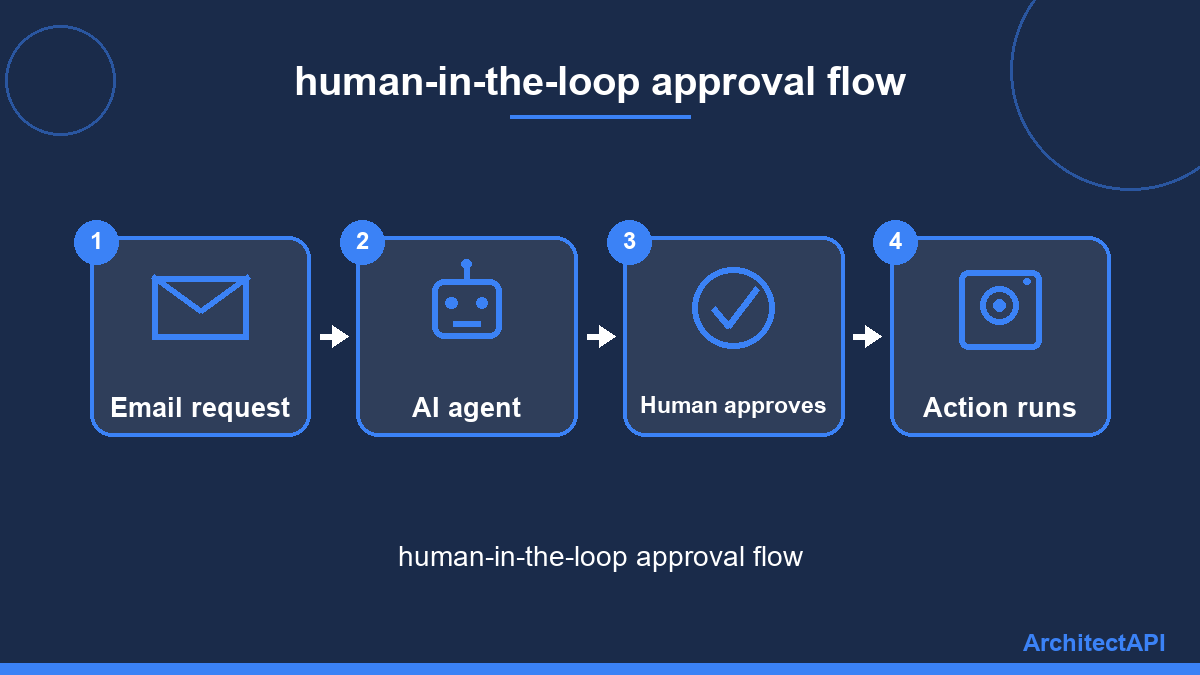
Human-in-the-loop is a setup where an AI agent's proposed action is reviewed and approved by a person before it takes effect. The process runs in four simple steps.
1. Spotting the task. The AI agent notices an incoming request, such as an email, an invoice, or a customer message, and figures out what needs to happen.
2. Drafting the action. It prepares the reply, the payment, or the report. Nothing leaves the system at this stage.
3. Sending it for approval. The prepared action is shown to you or a team member with a short summary. You approve it, reject it, or edit it.
4. Executing. Once approved, the action runs automatically. If it is not approved, nothing goes out.
This loop keeps the speed of automation while leaving the final call with a person.
How human-in-the-loop works at ArchitectAPI
ArchitectAPI's AI agent platform builds this principle into its core. Critical actions, like payments, contract approvals, or bulk emails, are never executed automatically. The agent prepares the work; you or a person you choose approves it with one click.
This is what sets ArchitectAPI apart from ordinary automation tools. You do not lose speed, and you do not lose control either. Every approval is logged, so you can always see who approved what and when it happened.
Which actions need human approval?
Not every task needs a person to sign off. Routine, low-risk work can run on its own; anything hard to undo should go through a person first.
Actions that typically need approval include: bank transfers or payment instructions, contracts or proposals sent to outside parties, permanent changes to a customer account, bulk email or message campaigns, and data deletion.
By contrast, low-stakes tasks like summarizing an invoice or drafting a report can usually run automatically. To see which processes carry which risk level, check ArchitectAPI's AI solutions page.
What happens without human-in-the-loop?
A system that runs with no human check can turn a small mistake into a big one fast. A payment sent to the wrong account, or a proposal sent to the wrong client, can reach dozens of people within hours.
The NIST AI Risk Management Framework points to human oversight as one of the core ways to reduce risk in critical decisions. That applies just as much to a one-person business as it does to a large company.
In short, human-in-the-loop is not a brake on your AI agent; it is a trust mechanism. You get the most out of automation when you keep control of the moment that matters most. To see which of your processes could use an approval step, take a look at ArchitectAPI's AI agent platform.
Frequently Asked Questions
What is the difference between human-in-the-loop and full automation? In full automation, the AI completes a task start to finish on its own. In a human-in-the-loop setup, the action is reviewed and approved by a person before it takes effect. The difference is who holds the final call.
Does human-in-the-loop slow down AI agents? The approval step usually takes seconds to a few minutes, so yes, there is a small delay. But it saves you the hours it takes to undo a mistake that reaches a customer. Overall, it saves time.
Which businesses should use human-in-the-loop? Nearly any business that handles payments, contracts, or customer data benefits from it. It matters most for small teams, where a single mistake can be costly, making human approval a cheap safety net.