Who answers when a customer messages you at midnight? Sometimes a chatbot, sometimes an AI agent. Both get called "AI," yet they do very different jobs. This guide explains the AI agent vs chatbot difference in plain language.
Here's the short version. A chatbot answers the question you ask it. An AI agent takes a goal and carries the whole task through, start to finish.
The difference sounds small. In daily work, it is not.
What Is a Chatbot, Exactly?
A chatbot works like a question-and-answer box. You type something, it replies with a stored or learned answer.
Think of a restaurant's booking bot. You ask "are you open on Sunday?" and it tells you. The conversation ends there.
A chatbot remembers what you said earlier in the chat, but it doesn't start new work on its own. It waits for your message, replies, then waits again.
Businesses use chatbots mostly for customer support: opening hours, order status, common questions. They reply fast, but they can't finish a multi-step task alone.
What Is an AI Agent?
An AI agent works on a different logic. You don't ask it a question, you give it a goal.
Say you tell it: "check this week's overdue invoices and send reminders." An AI agent doesn't just produce one answer.
First it checks which invoices are late. Then it decides who gets which message. Then it writes the messages and sends them.
In other words, an AI agent behaves more like an employee than an assistant. It carries a task through, uses the tools it needs, and reports back with a result.
AI Agent vs Chatbot Difference, Step by Step
Line them up side by side and the difference becomes clear.
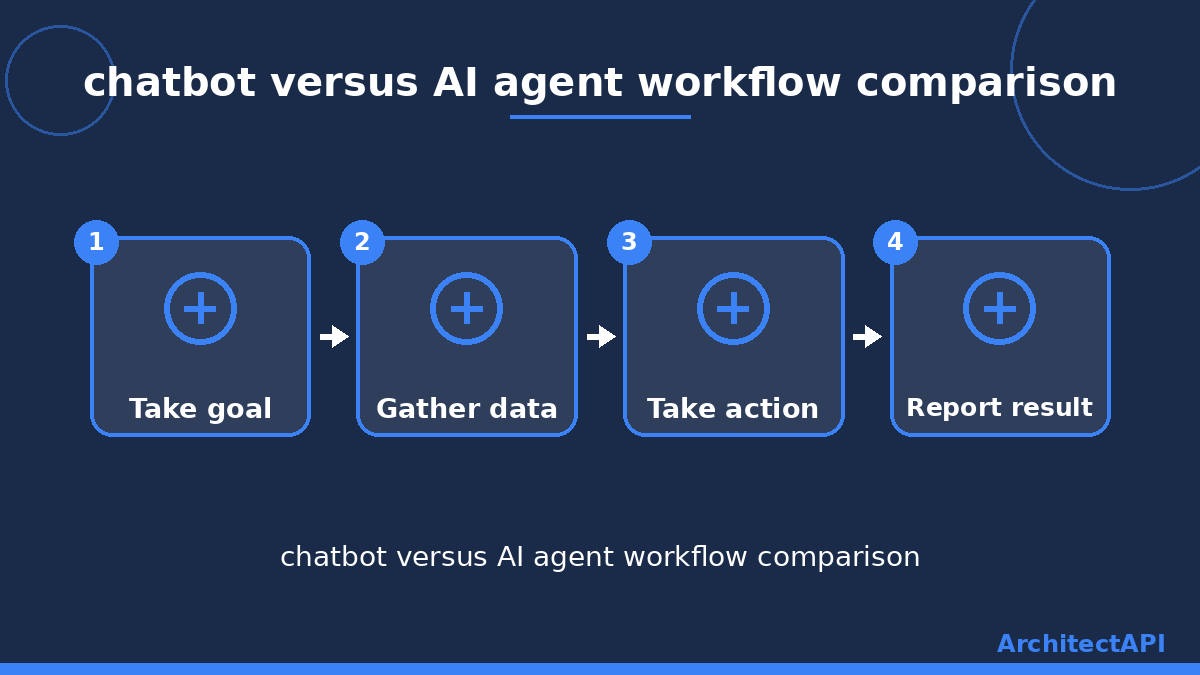
A chatbot answers one question and stops. An AI agent takes a goal, plans the steps itself, and keeps going until the job is done.
A chatbot only works with what it already knows. An AI agent can check other systems, pull data, and actually carry out an action.
With a chatbot, you drive every step. With an AI agent, you hand over the goal and it drives.
Salesforce describes agent-based systems as software that can "complete complex tasks autonomously," calling this the key trait that sets them apart from a standard chatbot (source). That description matches what most teams experience day to day.
Which One Fits Your Task?
Both have a place. The right question isn't "which is better," it's "which fits this job."
For short, repeated questions, a chatbot is enough: business hours, shipment status, common FAQs. It's quick to set up and cheap to run.
For tasks with several steps that end in a real action, an AI agent fits better: invoice checks, payment follow-up, report building.
Some businesses use both. The chatbot handles the first contact, and a more complex request gets handed to an AI agent.
Our AI agent platform page shows which kind of workflow fits which setup.
Chatbot or AI Agent? What to Check Before Deciding
Ask yourself three questions before choosing.
First: does the job end with one answer, or does it need several steps? One answer means a chatbot is enough.
Second: does the system need to pull data from elsewhere, or actually carry out an action? If so, look at an AI agent.
Third: how costly is a mistake here? For sensitive tasks, adding human approval to an AI agent makes the setup safer.
Starting small is always the safest path. Pick one process, measure the result, then expand. Our AI solutions page can help you find the right starting point.
Frequently Asked Questions
Is an AI agent smarter than a chatbot? Not smarter, just built for a different job. A chatbot is good at conversation, an AI agent is good at finishing tasks. Match the tool to the need instead of comparing intelligence.
Can a business use both at once? Yes, and that's often the most practical setup. The chatbot handles simple questions, and an AI agent takes on the more complex work. You get speed and depth together.
Is an AI agent harder to set up than a chatbot? Usually it needs a bit more planning, since it carries out a real action. With the right first project, setup can still be done in a few weeks.