Picture an assistant who only needs to hear "handle it" and takes care of the rest alone. That is exactly what people mean when they talk about agentic AI these days. This guide breaks it down in plain English, with no technical vocabulary required.
Here is the short version. Agentic AI is a type of artificial intelligence that understands a goal you give it, then plans and carries out the steps needed to reach that goal on its own. The word "agentic" comes from agency — the ability to act independently.
Think of it this way. A traditional AI tool is like a map that hands you directions. Agentic AI is closer to a driver who takes that map, gets behind the wheel, and drives you to the destination.
What Is Agentic AI, in Plain Terms?
Let's start with an everyday example. Picture an office assistant. You tell them, "set up tomorrow's meeting."
A good assistant does not ask you ten follow-up questions. They open the calendar, find a free slot, send the invite, and book the room if needed.
Agentic AI behaves the same way. You describe the outcome, and it works out the steps on its own.
IBM describes agentic AI as artificial intelligence that can accomplish a specific goal with limited supervision. The system designs its own workflow and uses the tools available to complete the task.
Three traits sit at the core of this. First, autonomy — the system keeps moving without constant direction. Second, goal-driven behavior — it works toward a defined outcome rather than acting at random. Third, adaptability — if it hits a snag, it can adjust its plan.
Put those three together, and you get a system that finishes work rather than just answering questions about it.
How Is Agentic AI Different from Traditional AI?
This is where most confusion sets in. One example clears it up.
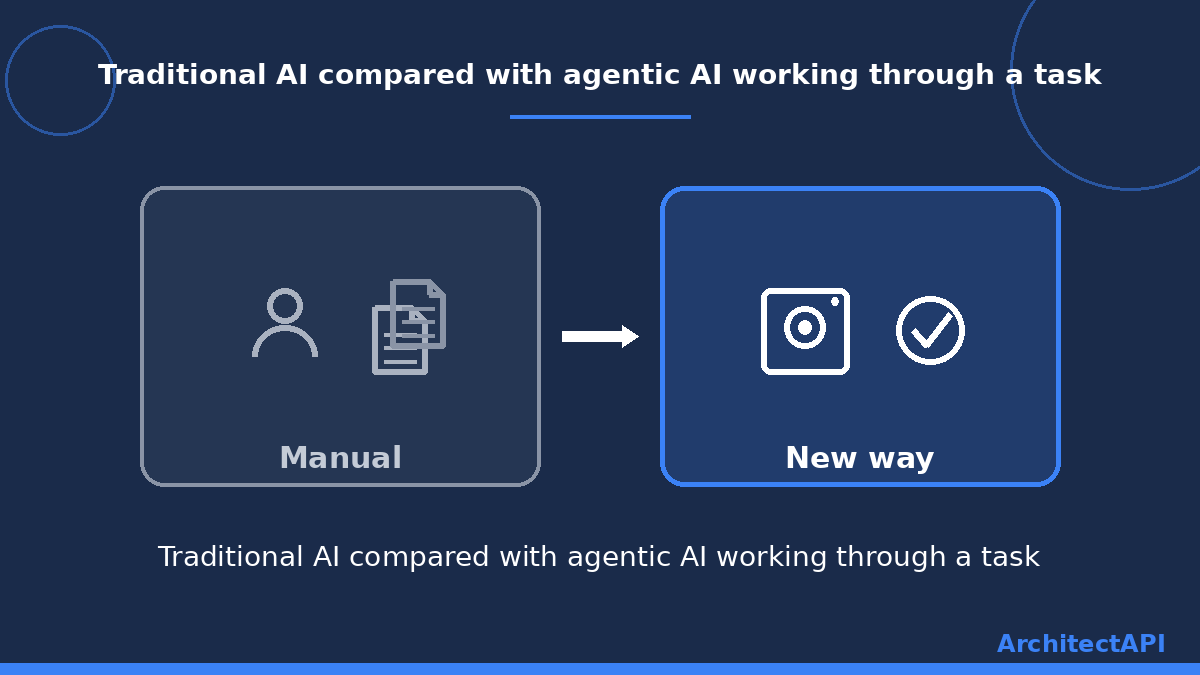
You type "summarize this month's expenses" into a classic chat window. It gives you an answer based on what it already knows, then stops. If it needs more information, it asks you.
Agentic AI moves differently. It opens the accounting records itself, pulls the relevant numbers, builds a table, and hands you both the summary and the table.
The first one reacts. The second one takes initiative. A traditional tool waits for your question; agentic AI works out the steps needed to reach the goal on its own.
There is a second difference. A classic system answers one question and the conversation ends there. Agentic AI can carry a ten-step task from start to finish, making its own calls along the way and checking the outcome.
In short, one gives you information, the other finishes the job. Our AI agent platform page shows how this plays out for real businesses.
How Does Agentic AI Actually Work?
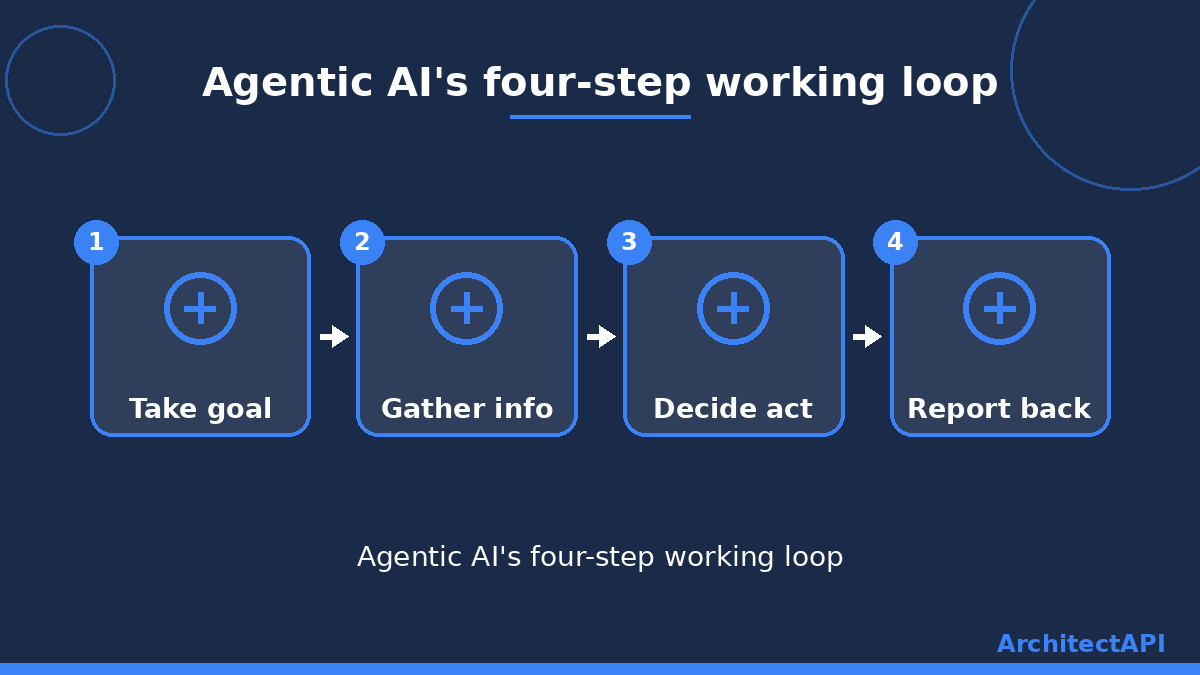
Nothing exotic happens behind the scenes. There are four straightforward steps.
Step one: it takes the goal. You define an outcome, such as "check incoming orders and flag anything out of stock."
Step two: it gathers what it needs. The system goes to wherever the information lives — a stock record, an order list, a customer file.
Step three: it decides and acts. It weighs what it has found, decides on the right move, and carries it out.
Step four: it checks and reports back. It reviews whether the work looks right. Where it is unsure, it pauses and asks you.
This loop is not a one-time list. As it sees results, it shapes the next step accordingly. That makes it a living way of working rather than a fixed checklist.
What Can Agentic AI Do for a Business?
The biggest payoff shows up in repetitive, clearly defined work. A few concrete examples help.
- Order and stock tracking: it checks incoming orders, looks at stock levels, and flags anything missing.
- Customer requests: it resolves the common questions end to end and hands the tricky ones to a person.
- Report building: it collects the weekly numbers, writes a short summary, and sends it to the right person.
- Document handling: it reads an incoming document, pulls out what matters, and files the record.
They all share one trait: they take time but do not require deep judgment. In most businesses, that kind of work fills the day of your most valuable employee.
So which jobs are not a good fit? Tasks with rules that shift constantly, like a delicate customer complaint or a price negotiation, tend to struggle.
Here's a simple test: if you can describe the job to a new hire in writing, agentic AI can likely handle most of it too.
Why Human Approval Still Matters
Let's be honest about the risk. These systems can still get things wrong.
Approving the wrong order or messaging the wrong customer gets expensive fast. That is why any serious setup keeps a seatbelt in place: human approval.
The system prepares the work, pauses at the critical step, and leaves the final call to you. Think of autopilot on a plane — it flies most of the journey, but the captain never leaves the seat.
That is how we build at ArchitectAPI. Anything hard to undo, such as money, contracts, or outbound messages, only runs after a person signs off. You set the approval threshold yourself — small tasks can go through directly, while bigger decisions always come back to you.
Over time that threshold can loosen. As the system proves itself, it takes on more of the work alone.
Where Should You Start?
Do not start with a sprawling project. That is the most common mistake by far.
Pick one task. Keep it small, dull, and repeated every week. Run it for a month and measure the hours you get back.
If the number convinces you, add a second task. This path looks slower on paper, but it is faster in practice, because your team learns to trust the system one step at a time.
If you are wondering where to start in your own business, take a look at our AI solutions page. It is usually the task everyone complains about.
Frequently Asked Questions
Is agentic AI the same thing as an AI agent? They are closely related. An AI agent refers to a single piece of software that pursues a goal on its own. Agentic AI is the broader term for that approach, emphasizing the system's ability to act autonomously. In practice, the two describe the same kind of work.
Is agentic AI safe to use? Yes, when it is set up correctly. As long as human approval covers critical decisions, the system will not step outside the boundaries you set. Safety mostly comes down to how tightly that approval step is enforced.
Does this make sense for a small business? Yes, and sometimes even more so. In a small company, repetitive work usually lands on the owner or the most experienced employee. If a single agentic AI setup saves a few hours a week, it pays for itself quickly.